Hatcher Pass
|
 Archives
|
 The Bottom Line
Strong to Extreme winds with gusts up to 42mph from the south/southeast have affected the forecast area for the last 12 hours. Winds are forecasted to subside this afternoon.
Human triggered wind slabs are likely at mid and upper elevations, on Northwest to North to Northeast aspects and cross-loaded features on slopes 35º degrees or steeper. Avalanches will be small to large in size. Natural avalanches are possible.
Human triggered persistent slab avalanches are possible at all elevations, on all aspects, on slopes 30º degrees or steeper. These avalanches will be large in size and 1-3+ feet deep.
Remotely triggering an avalanche is possible.
 Special Announcements
Please consider donating to HPAC during our matching funds campaign live until Feb 15. DONATE
Check out the February Square Powder Newsletter here.
Sign up for HPAC’s Square Powder Monthly Newsletter here.
Head over to Backcountry Bike and Ski and Fish Creek Sales for new HPAC ballcaps and buffs.


 |
|
|
 |
 |
|
| Travel Advice | Generally safe avalanche conditions. Watch for unstable snow on isolated terrain features. | Heightened avalanche conditions on specific terrain features. Evaluate snow and terrain carefully; identify features of concern. | Dangerous avalanche conditions. Careful snowpack evaluation, cautious route-finding, and conservative decision-making essential. | Very dangerous avalanche conditions. Travel in avalanche terrain not recommended. | Extraordinarily dangerous avalanche conditions. Avoid all avalanche terrain. |
| Likelihood of Avalanches | Natural and human-triggered avalanches unlikely. | Natural avalanches unlikely; human-triggered avalanches possible. | Natural avalanches possible; human-triggered avalanches likely. | Natural avalanches likely; human-triggered avalanches very likely. | Natural and human-triggered avalanches certain. |
| Avalanche Size and Distribution | Small avalanches in isolated areas or extreme terrain. | Small avalanches in specific areas; or large avalanches in isolated areas. | Small avalanches in many areas; or large avalanches in specific areas; or very large avalanches in isolated areas. | Large avalanches in many areas; or very large avalanches in specific areas. | Very large avalanches in many areas. |
There was one human triggered avalanche reported on Feb 5th. Click here for more info.
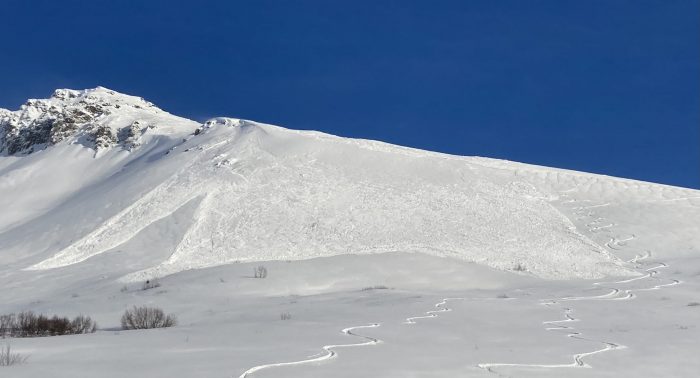
Government Creek- 3000′ West Southwest
| Signal Word | Size (D scale) | Simple Descriptor |
| Small | 1 | Unlikely to bury a person |
| Large | 2 | Can bury a person |
| Very Large | 3 | Can destroy a house |
| Historic | 4 & 5 | Can destroy part or all of a village |
The forecast area has been affected by strong to extreme winds from the south and south east. Marmot has reported strong southerly wind for the last 10 hours with gusts up to 42mph. Independence mine has also reported SE winds 18-34mph for the last 12 hours.
Human-triggered wind slabs 8-12” inches thick are likely on Northwest, North and Northeast aspects, at mid and upper elevations, on slopes 35º degrees or steeper. These avalanches will be small to large in size. Natural avalanches are possible. This avalanche problem will be short lived and avalanche conditions should improve in the next 24-48hrs.
It is possible if a wind slab avalanche occurs that it will step down into weak sugary snow below, triggering a persistent slab avalanche.
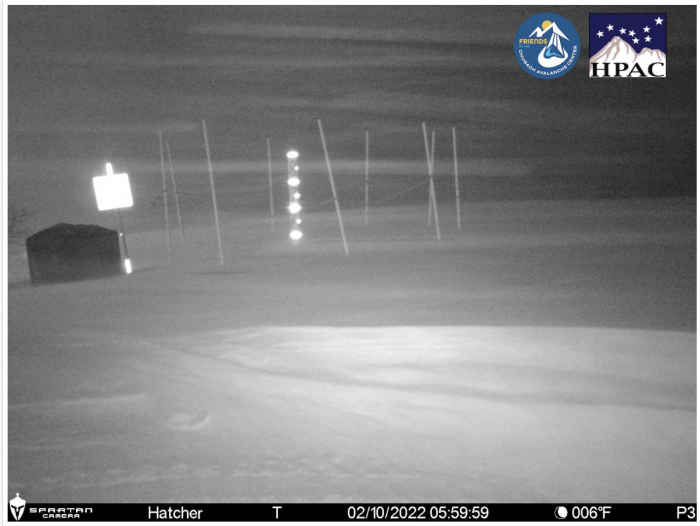
It’s windy at the snow stake!
To identify this avalanche problem, look for smooth wind-drifted snow and rounded lensed shape features. Anticipate wind drifted snow on northerly features and cross-loaded terrain features. Use hand pits and pole/probe tests to identify stiff hard snow sitting on top of soft low density snow. Whumping and shooting cracks are red flags for this avalanche problem.
These strong winds have created conditions for stiff hard wind slabs. Hard slabs are more likely to fail above you, allowing you to travel out onto a slope before they fail. Use safe travel techniques if you choose to travel in avalanche terrain. Spread out when ascending slopes, descend one at a time, and regroup out of harm’s way. Carry the appropriate avalanche rescue gear and know how to use it.
| Signal Word | Size (D scale) | Simple Descriptor |
| Small | 1 | Unlikely to bury a person |
| Large | 2 | Can bury a person |
| Very Large | 3 | Can destroy a house |
| Historic | 4 & 5 | Can destroy part or all of a village |
Large human triggered persistent slab avalanches 1-3+ feet deep are possible on all aspects, at all elevations, on slopes 30º degrees or steeper. Natural persistent slab avalanches are unlikely.
The structure of the snowpack is poor throughout most of the forecast area. In areas where the snowpack is thinner, SE, S and SW aspects and ridgetops, the chances of a human triggered avalanche are increased. Remotely triggering an avalanche is also a concern.
Since Saturday the forecast area has received up to a foot of new snow.
To identify the persistent slab problem, use pole/proves and formal stability tests. Whumping and shooting are red flags for this avalanche problem but may not occur prior to an avalanche being triggered.
There’s been several weather events this week, here’s a quick recap of significant weather events. On Feb 5th 7” of new snow fell in Hatcher Pass. This 7” of new snow fell with SE winds with gusts 22-24mphs for 11 hours. To further complicate things on Feb 5th strong winds from the North gusted up to 44 mph for 6 hours. On Feb 8th Independence mine got an additional 3-4” of new snow, with moderate winds from the south/southeast.
NWS AVG Forecast here.
NWS Rec Forecast here.
NWS point forecast here.
State Parks Snow Report and Motorized Access information here.