Hatcher Pass
|
 Archives
|
 The Bottom Line
In the last 24 hours Hatcher Pass has received 9″ of new snow.
Human triggered Storm Slab avalanches are likely at mid and upper elevations, on all aspects on slopes 35 degrees and steeper.
Human triggered loose dry avalanches are likely at mid and upper elevations on all aspects, in terrain 40 degrees or steeper.
Natural avalanches are possible.
 Special Announcements
Come join HPAC for a screening of the movie, BURIED, at our Beartooth fundraiser Thur March 24th. All new HPAC swag will be available for purchase.
HPAC will continue providing avalanche information till the end of our season April 16.


 |
|
|
 |
 |
|
| Travel Advice | Generally safe avalanche conditions. Watch for unstable snow on isolated terrain features. | Heightened avalanche conditions on specific terrain features. Evaluate snow and terrain carefully; identify features of concern. | Dangerous avalanche conditions. Careful snowpack evaluation, cautious route-finding, and conservative decision-making essential. | Very dangerous avalanche conditions. Travel in avalanche terrain not recommended. | Extraordinarily dangerous avalanche conditions. Avoid all avalanche terrain. |
| Likelihood of Avalanches | Natural and human-triggered avalanches unlikely. | Natural avalanches unlikely; human-triggered avalanches possible. | Natural avalanches possible; human-triggered avalanches likely. | Natural avalanches likely; human-triggered avalanches very likely. | Natural and human-triggered avalanches certain. |
| Avalanche Size and Distribution | Small avalanches in isolated areas or extreme terrain. | Small avalanches in specific areas; or large avalanches in isolated areas. | Small avalanches in many areas; or large avalanches in specific areas; or very large avalanches in isolated areas. | Large avalanches in many areas; or very large avalanches in specific areas. | Very large avalanches in many areas. |
No human triggered avalanches were reported this week. On Mar 6th several natural avalanches were observed.
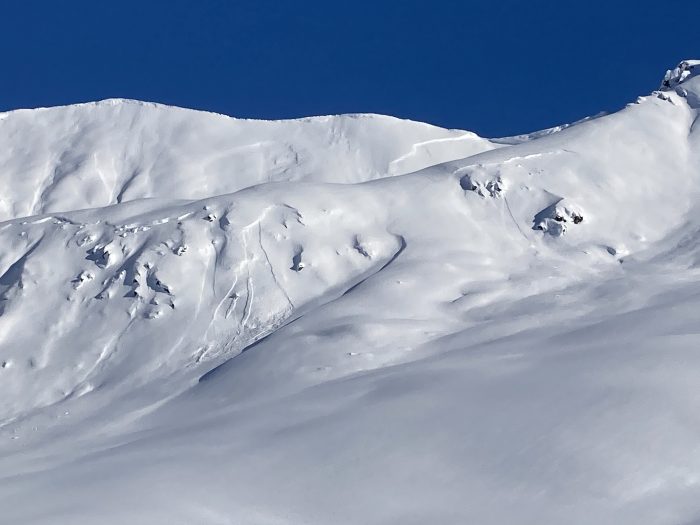
Loose Dry on the Willow side of Eldorado. Photo taken March 6th.
| Signal Word | Size (D scale) | Simple Descriptor |
| Small | 1 | Unlikely to bury a person |
| Large | 2 | Can bury a person |
| Very Large | 3 | Can destroy a house |
| Historic | 4 & 5 | Can destroy part or all of a village |
In the last 24 hours, 9 inches of snow has fallen, this new snow has SWE of 1.5″. This new snow will behave like a slab, creating a storm slab problem. Human triggered storm slabs up to 9″ thick are LIKELY at mid and upper elevations and all aspects, on slopes 35º and steeper. Natural avalanches are possible. These avalanches will be small in size.
To identify this avalanche problem use formal stability tests and hand pits, to see if this new snow is behaving like a slab. Small test slopes will be a tool to observe how your weight affects the snowpack and to see if the new snow is behaving like a slab. Shooting cracks will be a red flag for this avalanche problem.
DOT is working on clearing the road to Gold Mint. As we anticipate having more access to the backcountry, remember that there have been very few travelers in Hatcher Pass recently. Fewer travelers means that there have been minimal observations and less information on the snowpack. If you do choose to venture out in the mountains today, take a slow and thoughtful approach to assessing terrain and the snowpack. If your goal is to travel in steep terrain, start small and slowly work your way into more committing terrain.
Riding conditions have improved with the last two storms. In some areas old sun and drizzle crusts will be felt.
| Signal Word | Size (D scale) | Simple Descriptor |
| Small | 1 | Unlikely to bury a person |
| Large | 2 | Can bury a person |
| Very Large | 3 | Can destroy a house |
| Historic | 4 & 5 | Can destroy part or all of a village |
With all this new snow, human triggered Loose Dry avalanches will be likely at mid and upper elevations and all aspects on slopes 40º and steeper. Natural avalanches are possible. In some locations this new snow will sit on top of old sun crusts and drizzle crusts. Where these crusts exist Loose Dry avalanches will be able to gain speed quickly. Sluff management will be important if you choose to venture out into steeper terrain. Even a small avalanche can have severe consequences if traveling above terrain traps.