Hatcher Pass
|
 Archives
|
 The Bottom Line
Put on your game face if you’re headed to Hatcher Pass today. Tricky avalanche conditions exist.
Small to large human-triggered persistent slab avalanches are possible at mid and upper elevations on all aspects. Remotely triggered avalanches are possible. Natural avalanches are unlikely.
In the last 24hrs 3 of the 6 red flags for avalanches have been observed: Recent avalanches, shooting cracks, and collapsing(whumping).
Even a small avalanche could have severe consequences, due to shallow coverage and rocks.
 Special Announcements
Thank you to all of our donors who make HPAC forecasting a sustainable reality. We will be thanking supporters individually, and to the many anonymous givers in our community, we send our deepest gratitude.
To our new community members this season, welcome! Thank you for working with us to foster safer backcountry travel by reading the forecast and submitting your observations.
Please consider investing in professional avalanche forecasting in Hatcher Pass by clicking the red Donate button at the top of the screen.


| |
|
 |
 |
 |
|
| Travel Advice | Generally safe avalanche conditions. Watch for unstable snow on isolated terrain features. | Heightened avalanche conditions on specific terrain features. Evaluate snow and terrain carefully; identify features of concern. | Dangerous avalanche conditions. Careful snowpack evaluation, cautious route-finding, and conservative decision-making essential. | Very dangerous avalanche conditions. Travel in avalanche terrain not recommended. | Extraordinarily dangerous avalanche conditions. Avoid all avalanche terrain. |
| Likelihood of Avalanches | Natural and human-triggered avalanches unlikely. | Natural avalanches unlikely; human-triggered avalanches possible. | Natural avalanches possible; human-triggered avalanches likely. | Natural avalanches likely; human-triggered avalanches very likely. | Natural and human-triggered avalanches certain. |
| Avalanche Size and Distribution | Small avalanches in isolated areas or extreme terrain. | Small avalanches in specific areas; or large avalanches in isolated areas. | Small avalanches in many areas; or large avalanches in specific areas; or very large avalanches in isolated areas. | Large avalanches in many areas; or very large avalanches in specific areas. | Very large avalanches in many areas. |
Marmot SW face 3800’ Human triggered avalanche on 11/16
Hatcher Pass Road Willow side 3000’ North aspect. Remote triggered by a snowmachiner on 11/15
Marmot Gully 3, ESE, 3600′ – Natural avalanches on 11/14
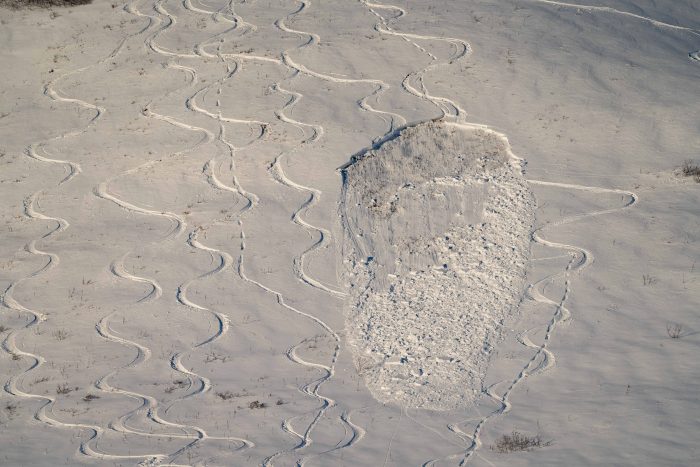
Powder Pimple SE aspect 2900’ human triggered avalanche on 11/15
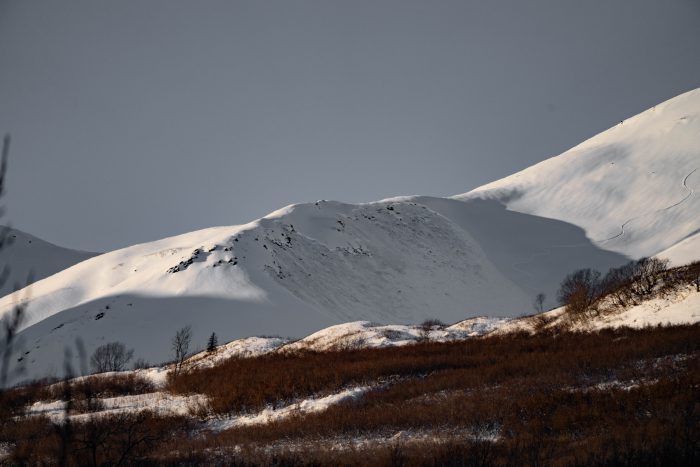
Peak 4600’ NE aspect remote trigger by a skier on 11/15
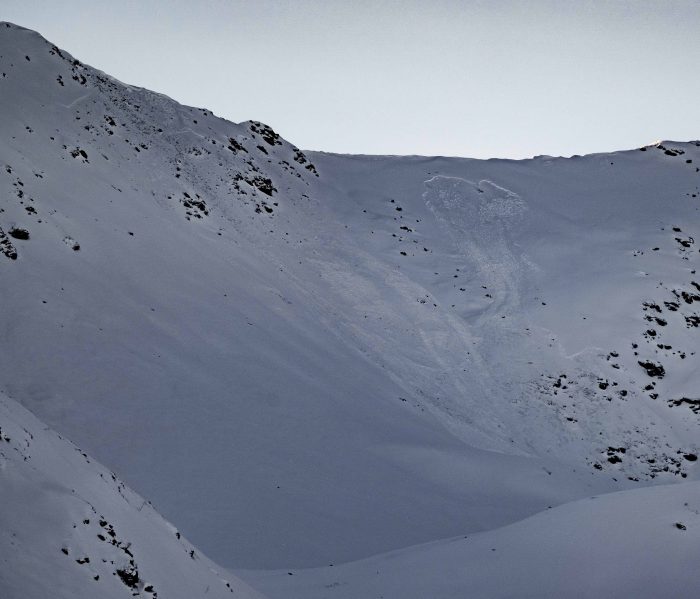
Near Woman’s Run North aspect 4000’ Natural Avalanche 11/14
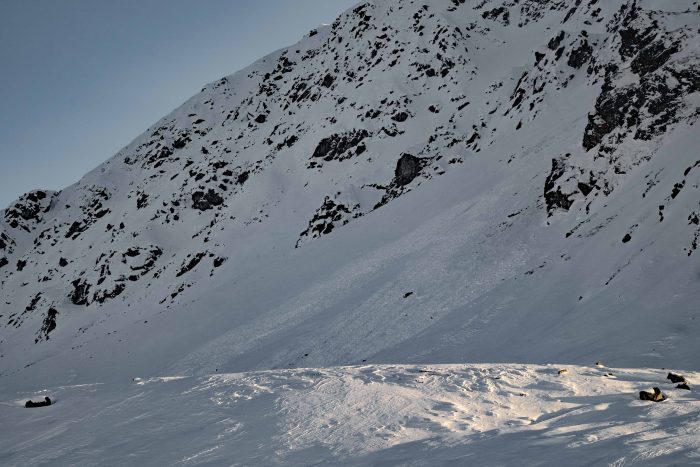
Lower Ray Wallace NW aspect 3700’ Natural Avalanche 11/14
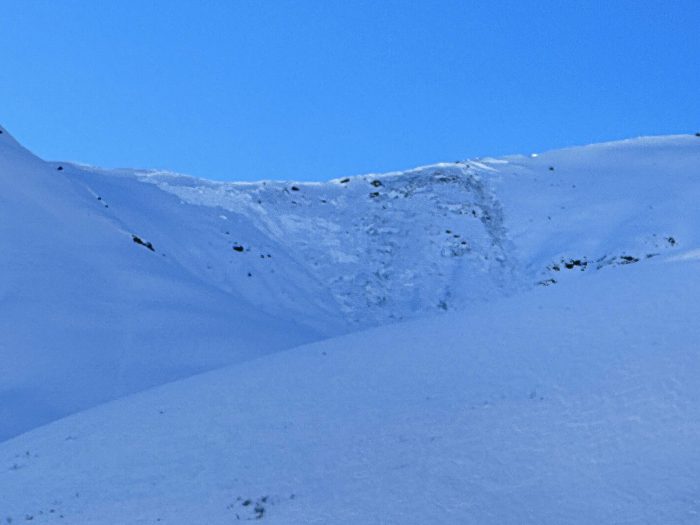
Skyscraper North, 4300’- Natural Avalanche on 11/14
| Signal Word | Size (D scale) | Simple Descriptor |
| Small | 1 | Unlikely to bury a person |
| Large | 2 | Can bury a person |
| Very Large | 3 | Can destroy a house |
| Historic | 4 & 5 | Can destroy part or all of a village |
Small to large human-triggered persistent slab avalanches are possible at upper and mid-elevations, on slopes 30º or steeper. This avalanche problem will be found on all aspects. Remotely triggering an avalanche from a distance is a real concern today.
The current snowpack structure is horrendously flawed and is still trying to adjust to the load from the storm on Nov 14th. Buried weak faceted snow can be found anywhere you look in the forecast area. What changes as you travel around the forecast area is the thickness of the slab sitting on top of these basal facets. It may be a week or more before we see significant improvement in stability.
In areas that are unaffected by the wind the snowpack is as thin as 10”. In areas with wind loading, the snowpack is up to three feet thick.
Areas that were previously wind-loaded should be easy to visually identify. To visually identify previously wind-loaded areas look for wind-drifted snow and round lensed shaped features.
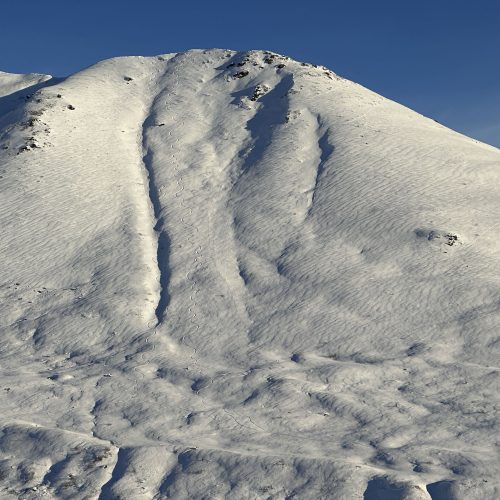
A good example of previous wind loading on SW face of Marmot. Picture taken at 12pm on 11/16.
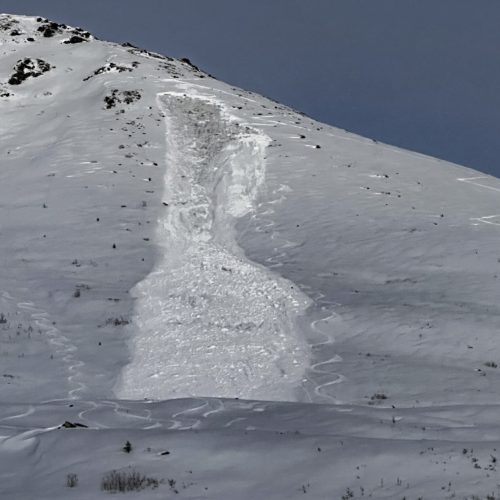
Same area as photo above. Human triggered avalanche around 3pm 11/16
We are in a tricky set of conditions where we will be tempted to recreate in the areas with better coverage. Unfortunately, this carries the added hazard of potentially triggering larger, deeper avalanches.
If caught in any size avalanche, the danger is compounded by shallow coverage, and the very real possibility of impacting rocks at high speed, potentially injuring or killing a person.
Tracks on slopes are not a sign of stability and should not be trusted to indicate safer locations to recreate. More than one avalanche has been triggered this week, with multiple sets of tracks already on the slope. Unfortunately, this means it’s very difficult to predict where and when triggering an avalanche will occur.
Recent avalanches, shooting Cracks, and whumping are all red flags for this avalanche problem. Use formal stability tests, pole probes, and hand pits to help you identify areas with a dense slab with weak snow underneath
Today’s travel advice is: