Hatcher Pass
|
 Archives
|
 The Bottom Line
Human triggered persistent slab avalanches are possible at all elevations, on all aspects, on slopes 30º degrees or steeper. Avalanches will be small to large in size. Natural avalanches are unlikely.
Remotely triggering an avalanche is possible.
Expect cloudy weather and poor visibility in Hatcher Pass today. 3 inches of new snow is expected to accumulate by tonight.
 Special Announcements
Check out the HPAC newsletter for more info on fundraising and where to pick up HPAC swag! Click here to sign up for the newsletter.

 |
|
 |
 |
 |
|
| Travel Advice | Generally safe avalanche conditions. Watch for unstable snow on isolated terrain features. | Heightened avalanche conditions on specific terrain features. Evaluate snow and terrain carefully; identify features of concern. | Dangerous avalanche conditions. Careful snowpack evaluation, cautious route-finding, and conservative decision-making essential. | Very dangerous avalanche conditions. Travel in avalanche terrain not recommended. | Extraordinarily dangerous avalanche conditions. Avoid all avalanche terrain. |
| Likelihood of Avalanches | Natural and human-triggered avalanches unlikely. | Natural avalanches unlikely; human-triggered avalanches possible. | Natural avalanches possible; human-triggered avalanches likely. | Natural avalanches likely; human-triggered avalanches very likely. | Natural and human-triggered avalanches certain. |
| Avalanche Size and Distribution | Small avalanches in isolated areas or extreme terrain. | Small avalanches in specific areas; or large avalanches in isolated areas. | Small avalanches in many areas; or large avalanches in specific areas; or very large avalanches in isolated areas. | Large avalanches in many areas; or very large avalanches in specific areas. | Very large avalanches in many areas. |
Several avalanches were remotely triggered by snow machines since the last forecast click here and here for more info. On 1/29 a natural avalanche cycle occurred.
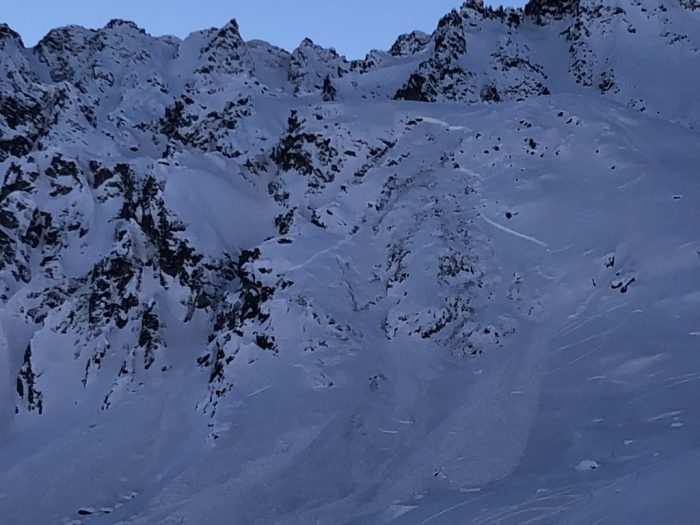
1/30 Remote trigger, Lane Valley. 10 people had skied the slope before a snow machine triggered this avalanche.
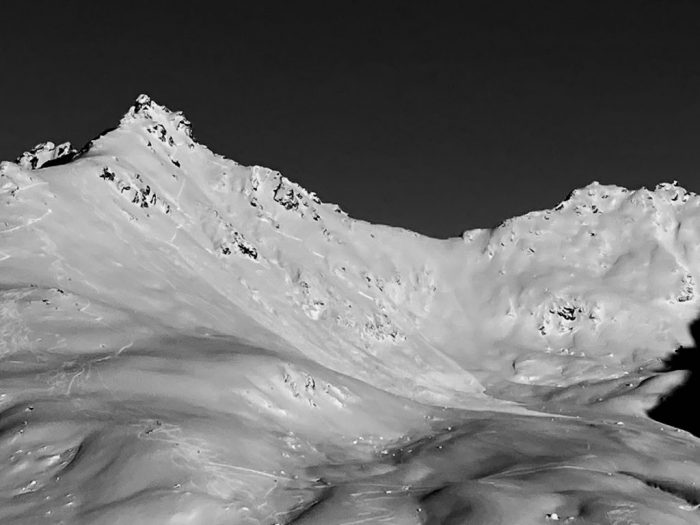
1/29 Natural , Microdot S 4400
| Signal Word | Size (D scale) | Simple Descriptor |
| Small | 1 | Unlikely to bury a person |
| Large | 2 | Can bury a person |
| Very Large | 3 | Can destroy a house |
| Historic | 4 & 5 | Can destroy part or all of a village |
Human triggered persistent slab avalanches 1-3’ are possible on all all aspects, at all elevations, on slopes 30º degrees or steeper. Natural avalanches are unlikely.
The structure of the snowpack is poor throughout all of the forecast area. Chances of a human triggered persistent slab avalanche are increased where the snowpack is thinner. The snowpack is thinner on SE, S and SW aspects, near ridge tops, and on the willow side of Hatcher Pass. All of the recent remote triggered avalanches occurred in rocky areas where the snowpack is thinner. These avalanches were also all triggered by snow machines. The depth of the snowpack is highly variable throughout the forecast area. On a south aspect yesterday, forecasters found a thin snowpack that was less than 1.5 feet deep. On north aspect nearby it was over 6 feet deep. It is easier to affect a weak layer where the snowpack is thinner, increasing the chances of a human or snow machine triggering an avalanche.
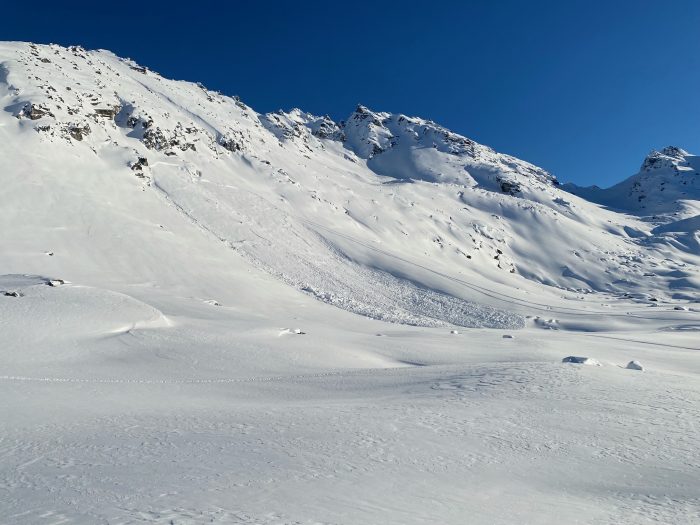
1/30 Southwest 4500′ This was a near miss and the snowmachiner was able to escape by riding off the slab.
To identify this avalanche problem use pole/probes and formal stability tests. Whumping and shooting cracks are red flags for this avalanche problem but may not occur prior to an avalanche being triggered
This persistent slab problem isn’t going anywhere and will likely be a concern for the rest of the season. Be disciplined when traveling in and around avalanche terrain. Practice safe travel techniques every time you head out into the mountains. Make sure you carry transceivers, probes and shovels and know how to use them. Remotely triggering an avalanche is a real concern in the forecast area.