Hatcher Pass Avalanche Center

Hatcher Pass RSS

Archives
ARCHIVED - Forecasts expire after 24 hours.
Issued
Sat, March 19th, 2022 - 7:00AM
Expires
Sun, March 20th, 2022 - 7:00AM
Forecaster
Allie Barker
Avalanche risk The Bottom Line

A short duration of wind on Friday formed small wind slabs that will be possible to human trigger above 3500′ on West to North aspects on slopes 35º and steeper.

Isolated large persistent slabs will be possible to human trigger between 3500′-4500′ on West to Northeast aspects on slopes 30º and steeper.

Temps barely froze at low elevation last night. Small loose wet avalanches will be possible to human trigger below 2500′ on SE, S, SW aspects.

Natural avalanches are unlikely.

Conditions include softened sun crusts, firm crusts, wind affected snow, and powder in protected locations on northerly aspects.

Expect 1-3 inches of new snow today with low visibility and calm winds.

Special Announcements

The Snowriders have groomed the corridor trail from Goldmint to the HP Lodge.  State Parks is working on marking the trail. Thank you! Take a ride up and support the HP Lodge. The road remains closed at mile 14/Goldmint.

Come join HPAC on Thursday for the movie, BURIED, at the Beartooth fundraiser Thur March 24th. Come buy some HPAC swag and support your local avalanche center.

Sat, March 19th, 2022
Upper Elevation
Above 3,500'
2 - Moderate
Avalanche risk
Mid Elevation
2,500'-3,500'
1 - Low
Avalanche risk
Low Elevation
Below 2,500'
1 - Low
Avalanche risk
0 - No Rating
1 - Low
2 - Moderate
3 - Considerable
4 - High
5 - Extreme
Avalanche risk Avalanche risk Avalanche risk Avalanche risk Avalanche risk
Travel Advice Generally safe avalanche conditions. Watch for unstable snow on isolated terrain features. Heightened avalanche conditions on specific terrain features. Evaluate snow and terrain carefully; identify features of concern. Dangerous avalanche conditions. Careful snowpack evaluation, cautious route-finding, and conservative decision-making essential. Very dangerous avalanche conditions. Travel in avalanche terrain not recommended. Extraordinarily dangerous avalanche conditions. Avoid all avalanche terrain.
Likelihood of Avalanches Natural and human-triggered avalanches unlikely. Natural avalanches unlikely; human-triggered avalanches possible. Natural avalanches possible; human-triggered avalanches likely. Natural avalanches likely; human-triggered avalanches very likely. Natural and human-triggered avalanches certain.
Avalanche Size and Distribution Small avalanches in isolated areas or extreme terrain. Small avalanches in specific areas; or large avalanches in isolated areas. Small avalanches in many areas; or large avalanches in specific areas; or very large avalanches in isolated areas. Large avalanches in many areas; or very large avalanches in specific areas. Very large avalanches in many areas.
Recent Avalanches

A couple small wind slabs were reported on Thursday on a west aspect in April bowl.
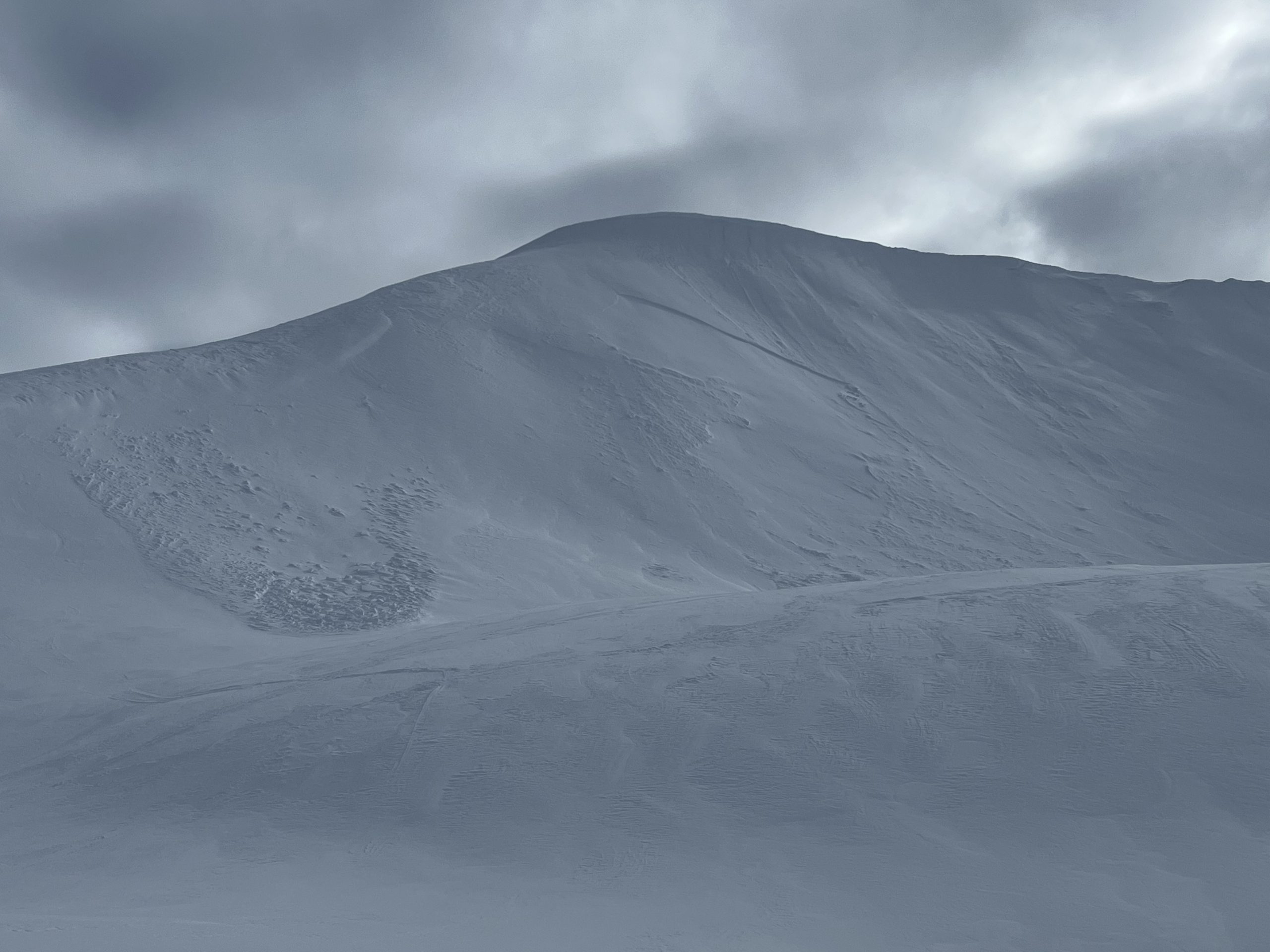
April Bowl

No other avalanches have been reported or observed since Thursday.

For avalanches earlier in the week look at Thursdays forecast or observations here .

Avalanche Problem 1
  • Wind Slabs
    Wind Slabs
  • Certain
    Very Likely
    Likely
    Possible
    Unlikely
    Likelihood
  • Historic (D4-5)
    Very Large (D3)
    Large (D2)
    Small (D1)
    Size
Wind Slabs
Wind Slab avalanches are the release of a cohesive layer of snow (a slab) formed by the wind. Wind typically transports snow from the upwind sides of terrain features and deposits snow on the downwind side. Wind slabs are often smooth and rounded and sometimes sound hollow, and can range from soft to hard. Wind slabs that form over a persistent weak layer (surface hoar, depth hoar, or near-surface facets) may be termed Persistent Slabs or may develop into Persistent Slabs.

Likelihood of Avalanches
Terms such as "unlikely", "likely", and "certain" are used to define the scale, with the chance of triggering or observing avalanches increasing as we move up the scale. For our purposes, "Unlikely" means that few avalanches could be triggered in avalanche terrain and natural avalanches are not expected. "Certain" means that humans will be able to trigger avalanches on many slopes, and natural avalanches are expected.

Size of Avalanches
Avalanche size is defined by the largest potential avalanche, or expected range of sizes related to the problem in question. Assigned size is a qualitative estimate based on the destructive classification system and requires specialists to estimate the harm avalanches may cause to hypothetical objects located in the avalanche track (AAA 2016, CAA 2014). Under this schema, "Small" avalanches are not large enough to bury humans and are relatively harmless unless they carry people over cliffs or through trees or rocks. Moving up the scale, avalanches become "Large" enough to bury, injure, or kill people. "Very Large" avalanches may bury or destroy vehicles or houses, and "Historic" avalanches are massive events capable of altering the landscape.

Signal Word Size (D scale) Simple Descriptor
Small 1 Unlikely to bury a person
Large 2 Can bury a person
Very Large 3 Can destroy a house
Historic 4 & 5 Can destroy part or all of a village
More info at Avalanche.org

Winds picked up Friday gusting E 20 to 26 mph for a short duration but long enough to build small wind slabs.

It will be possible to human trigger small wind slabs 3 to 5″ thick on West to North aspects above 3500′ on slopes steeper than 35°. Natural avalanches are unlikely.

Flagging was observed as wind slabs were slowly forming at 4300′ on Skyscraper ridgeline during our tour on Friday. We expect wind slabs to be thicker and more sensitive on the Arkose ridgeline where winds are typically stronger.
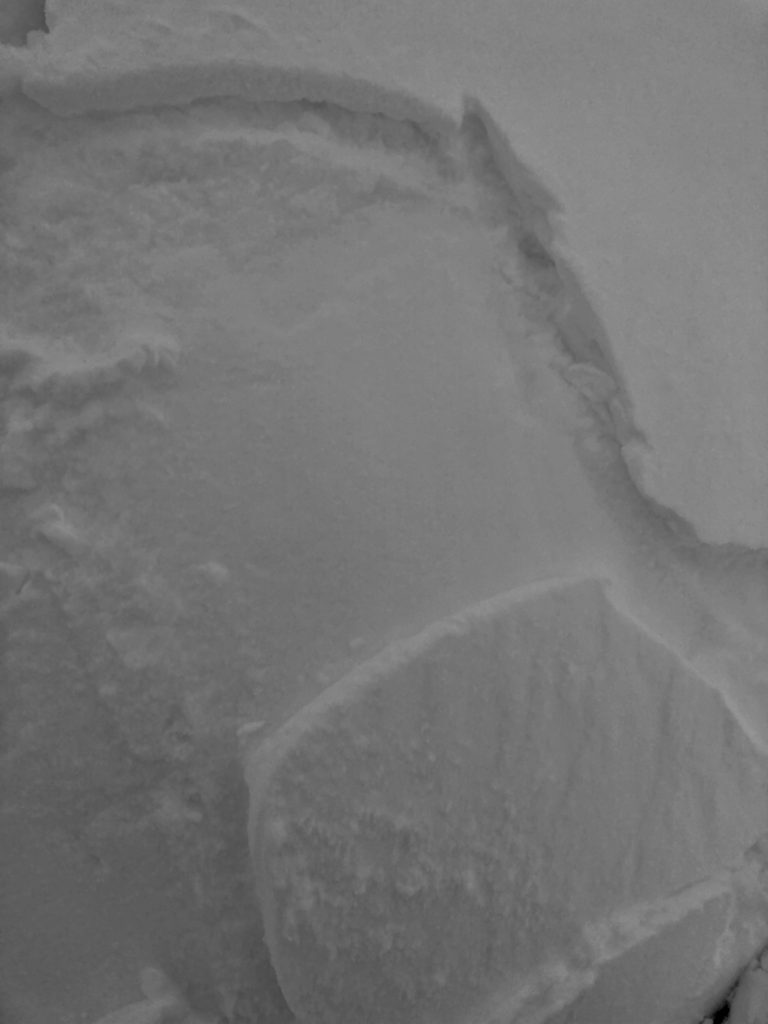
 

Small wind slabs forming Friday afternoon in Eldorado bowl

To identify this avalanche problem use pole/probe, hand pits and formal stability tests. Look for stiff hard snow sitting on top of low density snow. Shooting cracks and whumping will be red flags for this avalanche problem. Look for smooth wind drifted snow to visually identify this problem.

Wind slabs will be short lived and typically heal within 24-48hrs after the wind diminishes.

Avalanche Problem 2
  • Persistent Slabs
    Persistent Slabs
  • Certain
    Very Likely
    Likely
    Possible
    Unlikely
    Likelihood
  • Historic (D4-5)
    Very Large (D3)
    Large (D2)
    Small (D1)
    Size
Persistent Slabs
Persistent Slab avalanches are the release of a cohesive layer of snow (a slab) in the middle to upper snowpack, when the bond to an underlying persistent weak layer breaks. Persistent layers include: surface hoar, depth hoar, near-surface facets, or faceted snow. Persistent weak layers can continue to produce avalanches for days, weeks or even months, making them especially dangerous and tricky. As additional snow and wind events build a thicker slab on top of the persistent weak layer, this avalanche problem may develop into a Deep Persistent Slab.

Likelihood of Avalanches
Terms such as "unlikely", "likely", and "certain" are used to define the scale, with the chance of triggering or observing avalanches increasing as we move up the scale. For our purposes, "Unlikely" means that few avalanches could be triggered in avalanche terrain and natural avalanches are not expected. "Certain" means that humans will be able to trigger avalanches on many slopes, and natural avalanches are expected.

Size of Avalanches
Avalanche size is defined by the largest potential avalanche, or expected range of sizes related to the problem in question. Assigned size is a qualitative estimate based on the destructive classification system and requires specialists to estimate the harm avalanches may cause to hypothetical objects located in the avalanche track (AAA 2016, CAA 2014). Under this schema, "Small" avalanches are not large enough to bury humans and are relatively harmless unless they carry people over cliffs or through trees or rocks. Moving up the scale, avalanches become "Large" enough to bury, injure, or kill people. "Very Large" avalanches may bury or destroy vehicles or houses, and "Historic" avalanches are massive events capable of altering the landscape.

Signal Word Size (D scale) Simple Descriptor
Small 1 Unlikely to bury a person
Large 2 Can bury a person
Very Large 3 Can destroy a house
Historic 4 & 5 Can destroy part or all of a village
More info at Avalanche.org

Large isolated persistent slabs will be possible to human trigger on West to Northeast aspects between 3500-4500′ on slopes steeper than 30º. Natural avalanches are unlikely.

Although this problem still exists in isolated locations, it is hard to find BSH standing up (vs laying down) and is becoming more unlikely to trigger. We found buried surface hoar (BSH) approximately 12″ deep in every pit above 3500′ this week on W to NE aspects however it was laying down, decomposing, and mostly unreactive.
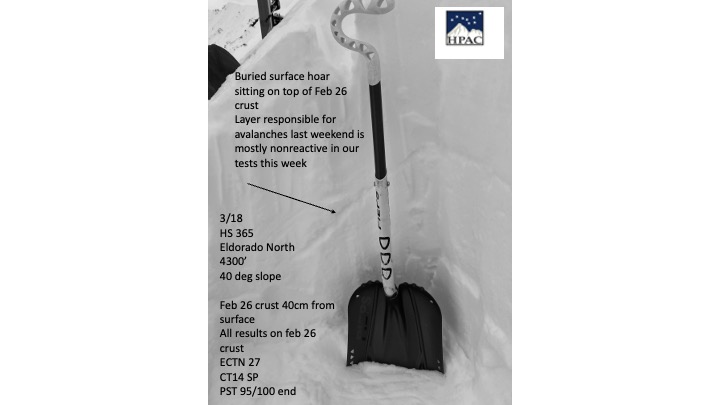
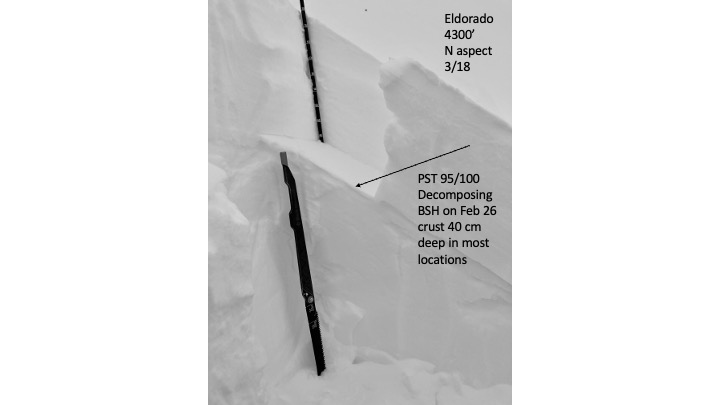


3/18 Buried surface hoar found at 4300′ N Eldorado

To identify this avalanche problem use hand pits, pole/probes and formal stability tests. There is no reason to not dig a pit with this layer only 12″ deep!

Whumping and shooting cracks are red flags for this avalanche problem.

You might wonder, why we don’t we ever talk about buried surface hoar at Hatcher Pass. The answer is the wind typically knocks it down before it gets buried. Surface hoar on the surface is beautiful and fun to look at, buried surface hoar is a whole other monster.  Avalanches that fail on BSH can have crowns that propagate wide and far, wrapping ridges and will fracture above you.

If you find buried surface hoar that is standing up with its arms in the air.. we have a quest for you. Take a picture, note the elevation, aspect, and date and we will buy you a beer at the Hatcher Pass lodge!

Our confidence is moderate to high with this problem existing within our forecast area.

Avalanche Problem 3
  • Wet Loose
    Wet Loose
  • Certain
    Very Likely
    Likely
    Possible
    Unlikely
    Likelihood
  • Historic (D4-5)
    Very Large (D3)
    Large (D2)
    Small (D1)
    Size
Wet Loose
Wet Loose avalanches are the release of wet unconsolidated snow or slush. These avalanches typically occur within layers of wet snow near the surface of the snowpack, but they may quickly gouge into lower snowpack layers. Like Loose Dry Avalanches, they start at a point and entrain snow as they move downhill, forming a fan-shaped avalanche. Other names for loose-wet avalanches include point-release avalanches or sluffs. Loose Wet avalanches can trigger slab avalanches that break into deeper snow layers.

Likelihood of Avalanches
Terms such as "unlikely", "likely", and "certain" are used to define the scale, with the chance of triggering or observing avalanches increasing as we move up the scale. For our purposes, "Unlikely" means that few avalanches could be triggered in avalanche terrain and natural avalanches are not expected. "Certain" means that humans will be able to trigger avalanches on many slopes, and natural avalanches are expected.

Size of Avalanches
Avalanche size is defined by the largest potential avalanche, or expected range of sizes related to the problem in question. Assigned size is a qualitative estimate based on the destructive classification system and requires specialists to estimate the harm avalanches may cause to hypothetical objects located in the avalanche track (AAA 2016, CAA 2014). Under this schema, "Small" avalanches are not large enough to bury humans and are relatively harmless unless they carry people over cliffs or through trees or rocks. Moving up the scale, avalanches become "Large" enough to bury, injure, or kill people. "Very Large" avalanches may bury or destroy vehicles or houses, and "Historic" avalanches are massive events capable of altering the landscape.

Signal Word Size (D scale) Simple Descriptor
Small 1 Unlikely to bury a person
Large 2 Can bury a person
Very Large 3 Can destroy a house
Historic 4 & 5 Can destroy part or all of a village
More info at Avalanche.org

Temperatures at 2700′ hovered at 32º/freezing last night. If this pattern continues expect to see more wet avalanches at low elevation this weekend.

Small loose wet avalanches will be possible to human trigger at low elevation today.

The temps have been trending warmer every day. Pay attention to this as it is an indicator of larger wet avalanche problems to come this spring.

  • Manage loose avalanches by staying out of constricting terrain, like drainage gullies, and moving out of the fall line so you don’t get caught by your own sluff.
  • Avoid being caught and pulled into terrain traps below you like trees, gullies, or benches.
  • Roller balls, pinwheels, and natural sluffs of wet surface snow indicate potential for more wet activity.
  • Natural loose wet avalanches could start in rock bands or cliffy areas and fan out, entraining moist surface snow on steep slopes below.


Weather
Sat, March 19th, 2022

NWS AVG Forecast here.

NWS Rec Forecast here.

NWS point forecast here.

State Parks Snow Report and Motorized Access information here.

Observations
Recent Observations for Hatcher Pass