Hatcher Pass
|
 Archives
|
 The Bottom Line
Human triggered persistent slab avalanches are possible at mid and upper elevations, on all aspects, in slopes 30º or steeper. Avalanches will be small to large in size, natural avalanches are unlikely.
Remotely triggered avalanches are possible.
Small loose dry avalanches are possible at mid and upper elevations and on all aspects. Human triggered avalanches are possible on slopes 40º degrees or steeper. Natural avalanches are unlikely.
 Special Announcements
HPAC is unfortunately canceling our annual “Cabin Fever Reliever” fundraiser (2/6/2022) due to rising COVID-19 case numbers in our community. Please donate via the website to support your local avalanche center.
We have lots of new items for sale including original HPAC ball caps, buffs, limited edition beer mugs, and tote bags. Stay tuned for more info on where to pick up some HPAC items!
Contact andydennis@hpavalanche.org for any questions or if you would like to learn about business sponsorship ideas.
Look for a major fundraising push in the near future.


| |
|
 |
 |
 |
|
| Travel Advice | Generally safe avalanche conditions. Watch for unstable snow on isolated terrain features. | Heightened avalanche conditions on specific terrain features. Evaluate snow and terrain carefully; identify features of concern. | Dangerous avalanche conditions. Careful snowpack evaluation, cautious route-finding, and conservative decision-making essential. | Very dangerous avalanche conditions. Travel in avalanche terrain not recommended. | Extraordinarily dangerous avalanche conditions. Avoid all avalanche terrain. |
| Likelihood of Avalanches | Natural and human-triggered avalanches unlikely. | Natural avalanches unlikely; human-triggered avalanches possible. | Natural avalanches possible; human-triggered avalanches likely. | Natural avalanches likely; human-triggered avalanches very likely. | Natural and human-triggered avalanches certain. |
| Avalanche Size and Distribution | Small avalanches in isolated areas or extreme terrain. | Small avalanches in specific areas; or large avalanches in isolated areas. | Small avalanches in many areas; or large avalanches in specific areas; or very large avalanches in isolated areas. | Large avalanches in many areas; or very large avalanches in specific areas. | Very large avalanches in many areas. |
There were numerous natural avalanches that occurred on Jan 25th. On Jan 25th one human triggered avalanche occurred on 4068 and one remote triggered avalanche was reported in upper Willow Creek. Click here for more info on recent avalanches.
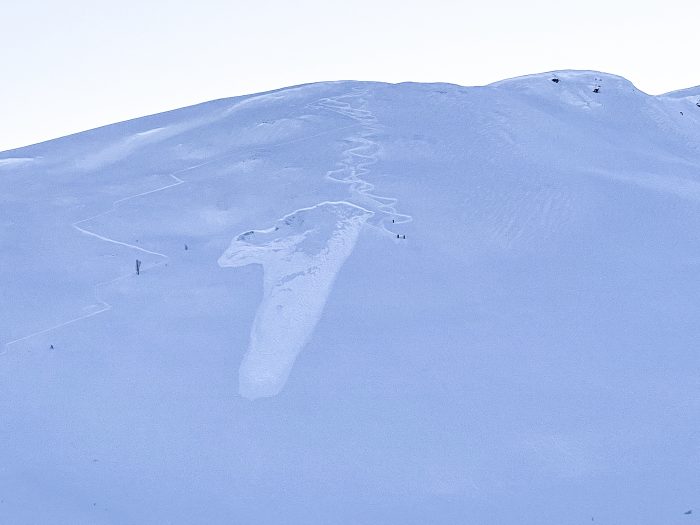
4068′ NE aspect 3200′- Human triggered
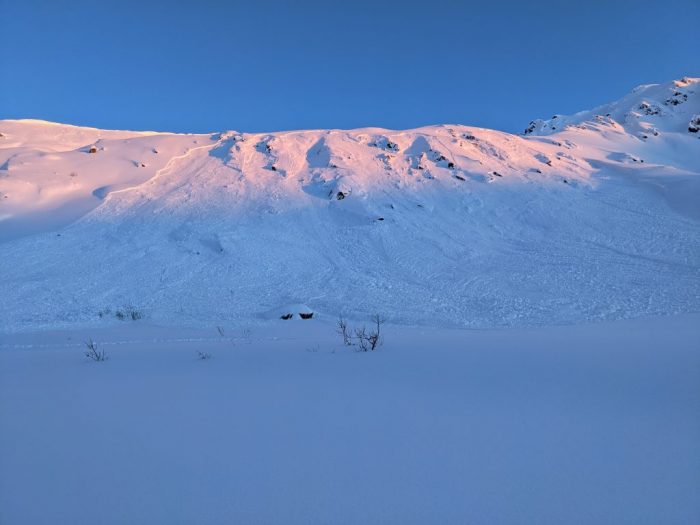
Upper Willow Creek 4000ft, WNW
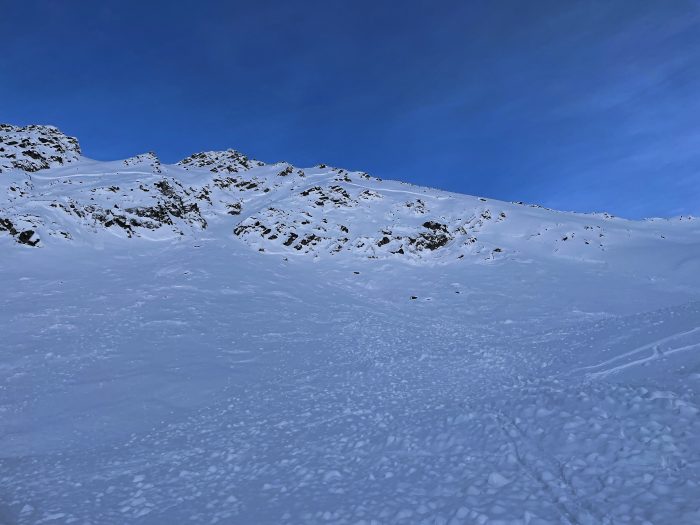
Nosehairs, SE/S aspects 4400’/4600′- approx 1000-1500′ wide x 800′ long x 2-3 ft deep
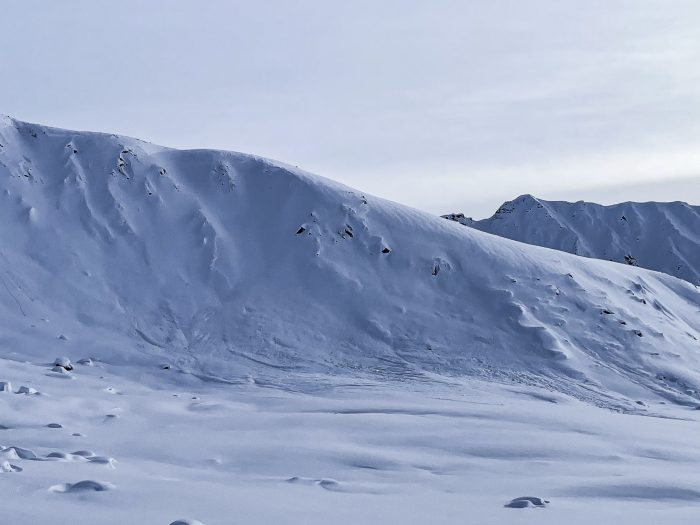
Natural Avalanche backside of Microdot NW 4100′
| Signal Word | Size (D scale) | Simple Descriptor |
| Small | 1 | Unlikely to bury a person |
| Large | 2 | Can bury a person |
| Very Large | 3 | Can destroy a house |
| Historic | 4 & 5 | Can destroy part or all of a village |
Persistent slab avalanches are possible at mid and upper elevations. The structure of the snowpack is poor on all aspects but chances of human triggered avalanches are increased where the snowpack is thin and easier to affect weak layers. Areas with a thinner snowpack can be found on Southerly aspects and near ridge lines. The Willow side of Hatcher Pass has a much thinner snowpack. These avalanches will be small to large in size. Human triggered avalanches are possible and natural avalanches are unlikely.
On Jan 24-25th 8-9 inches of new snow fell. These weather events were responsible for a natural avalanche cycle on 25th.
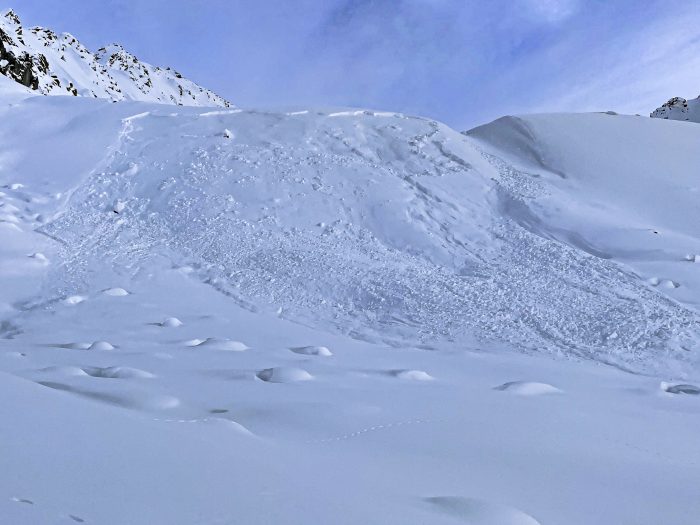
Murphy Bench 3900′ SW
To identify this avalanche problem and areas with poor structure use pole/probes and formal stability tests. Whumping and shooting cracks are red flags for this avalanche problem but may not occur prior to an avalanche being triggered.

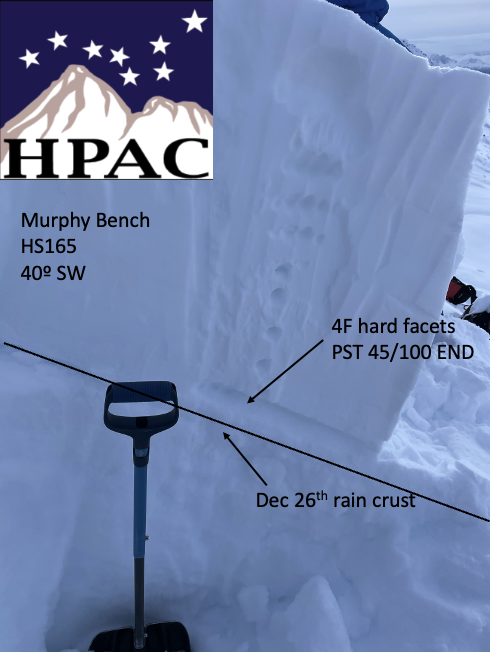
Riding quality has improved dramatically but don’t let soft snow cause you to throw safe travel techniques out the window. Spread out when ascending slopes, descend slopes one at a time, and stop in safe zones outside of the runout zone of avalanches. Even a small avalanche can have severe consequences if traveling above a terrain trap.
Remote triggering avalanches is a concern out in the backcountry today. Give avalanche terrain some extra space. Be extra cautious if you can’t see terrain that’s above you.
| Signal Word | Size (D scale) | Simple Descriptor |
| Small | 1 | Unlikely to bury a person |
| Large | 2 | Can bury a person |
| Very Large | 3 | Can destroy a house |
| Historic | 4 & 5 | Can destroy part or all of a village |
Loose Dry Avalanches are possible at mid and upper elevations and on all aspects, on slopes 40 degrees or steeper. These avalanches will be small in size, natural avalanches are unlikely.
If you choose to enter steeper terrain use proper sluff management. Know what’s below you. Even a small dry loose avalanche can knock you off your feet and push you over cliffs, into rocks and other hazards.