Hatcher Pass
|
 Archives
|
 The Bottom Line
Tricky conditions with high consequences continue to plague Hatcher Pass.
If you enter avalanche terrain space out using safe travel protocols and stay well out of the way of other people.
Small to large human-triggered persistent slab avalanches 1-3′ deep are possible at mid and upper elevations on all aspects. Remotely triggered avalanches are possible. Natural avalanches are unlikely.
Previous tracks are not a sign of stability. Numerous avalanches have been triggered by following other tracks.
Being swept away in any size avalanche carries the added consequence of being thrashed through rocks due to shallow coverage.
 Special Announcements
Interested in regular updates from HPAC? Sign up for our newsletter HERE!


| |
|
 |
 |
 |
|
| Travel Advice | Generally safe avalanche conditions. Watch for unstable snow on isolated terrain features. | Heightened avalanche conditions on specific terrain features. Evaluate snow and terrain carefully; identify features of concern. | Dangerous avalanche conditions. Careful snowpack evaluation, cautious route-finding, and conservative decision-making essential. | Very dangerous avalanche conditions. Travel in avalanche terrain not recommended. | Extraordinarily dangerous avalanche conditions. Avoid all avalanche terrain. |
| Likelihood of Avalanches | Natural and human-triggered avalanches unlikely. | Natural avalanches unlikely; human-triggered avalanches possible. | Natural avalanches possible; human-triggered avalanches likely. | Natural avalanches likely; human-triggered avalanches very likely. | Natural and human-triggered avalanches certain. |
| Avalanche Size and Distribution | Small avalanches in isolated areas or extreme terrain. | Small avalanches in specific areas; or large avalanches in isolated areas. | Small avalanches in many areas; or large avalanches in specific areas; or very large avalanches in isolated areas. | Large avalanches in many areas; or very large avalanches in specific areas. | Very large avalanches in many areas. |
Recent avalanches have varied in size from D1-2, 1-3′ deep, approximately 60-100 feet wide and in the case of the human-triggered avalanche on peak 4600, we are estimating 400-600 feet wide.
Numerous recent avalanches have been documented in observations and in the forecast.
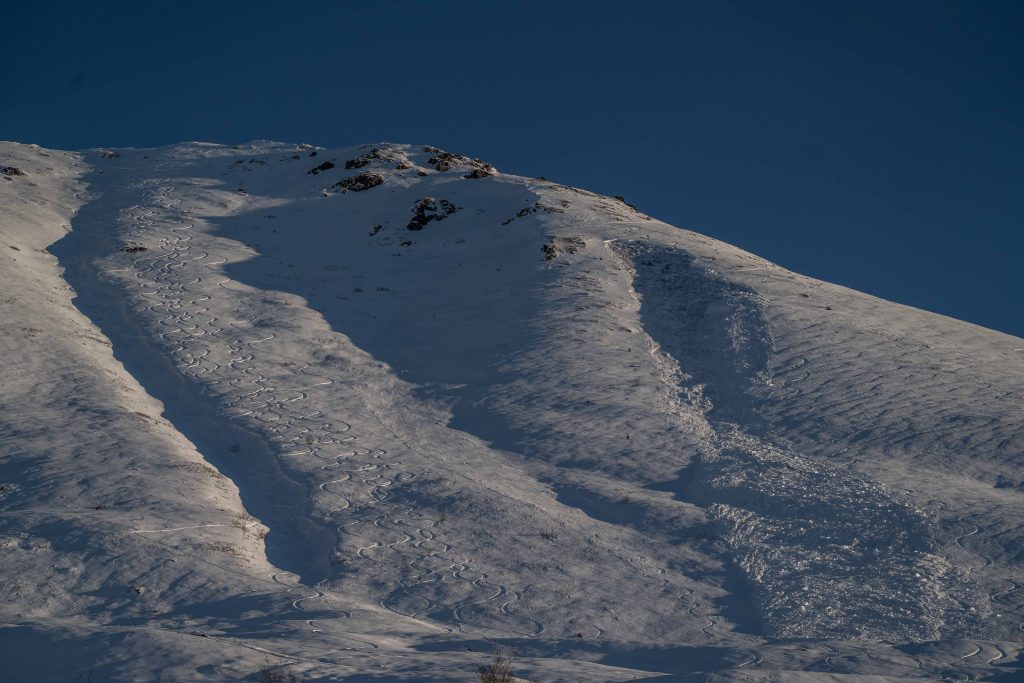
Marmot SW face 3800’ Human triggered avalanche on 11/16. Crown depth estimated 2-3 feet deep, 80 feet wide, ran 1500′, D2
| Signal Word | Size (D scale) | Simple Descriptor |
| Small | 1 | Unlikely to bury a person |
| Large | 2 | Can bury a person |
| Very Large | 3 | Can destroy a house |
| Historic | 4 & 5 | Can destroy part or all of a village |
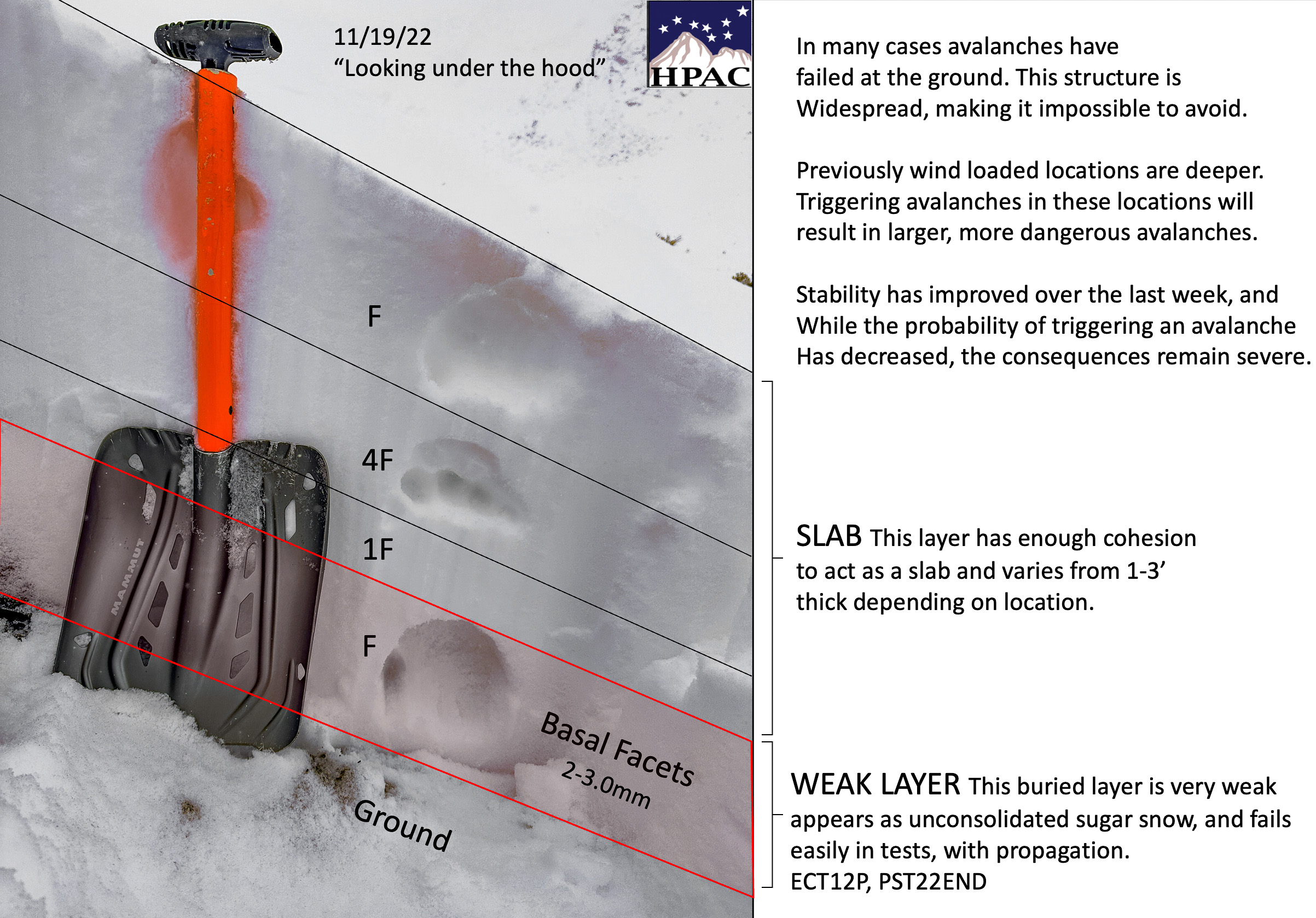
Small to large human-triggered persistent slab avalanches, 1-3 feet deep, are possible at upper and mid-elevations, on slopes 30º or steeper. This avalanche problem will be found on all aspects. Remotely triggering an avalanche from a distance is possible and poses a special hazard with high uncertainty.
The probability of triggering an avalanche is not high, however, the consequences of being caught in an avalanche and raked through rocks are.
There is a combination of factors present that make the avalanche situation very tricky. The possibility of triggering a remote avalanche from a distance adds a complex level of uncertainty. Tracks on slopes are NOT a sign of stability. A number of recent avalanches have been triggered by subsequent parties.
Outsmarting this avalanche problem is a dubious proposition.
Avalanches, widespread collapses, and shooting cracks have all recently been observed for the last 5 days. The last reported human-triggered avalanche was on 11/16. Instability testing has consistently shown unstable results, alarmingly poor structure, and repeated testing over the last week has not shown a significant trend for the better.
This week has seen some traffic and not a lot of people testing slopes, while some avalanche results have given us pause. It’s a numbers game. If we crowd the slopes, tick off more and more lines, and keep nibbling, we increase the chances of triggering more avalanches.
It’s the start of the winter season and we all want to get out and play in the snow, but under the current situation, we will all need to temper our appetite, be smart in our decision-making, make conservative decisions, and be disciplined with our travel protocol:
Test below on Hatch Peak, Powder Pimple, East, 3000′. Poor structure, weak basal sugary facets showing crack propagation. Instability testing is clearly and consistently demonstrating human triggering avalanches is possible. For more details see recent observations, including one from forecasters yesterday.